Dimensional Memorandum
.png)
A hub for scientific resources.

JWST measures the formation of the earliest galaxies, stars, and large-scale structures in the infrared. LOFAR maps the low-frequency radio universe, revealing diffuse plasma, magnetic environments, jets, filaments, and structures that can remain nearly invisible at optical wavelengths. DESI traces the three-dimensional distribution of millions of galaxies and quasars, measuring how cosmic structure evolves across enormous distances and timescales. The Vera C. Rubin Observatory adds a continuously changing view of the sky, following billions of objects and mapping gravitational lensing, dark matter structure, transients, and cosmic evolution.
Gravitational measurements add another layer. General relativity describes gravity as geometry: matter and energy influence spacetime, and the geometry of spacetime determines the motion of matter and light. Gravitational lensing therefore allows us to infer structure that cannot necessarily be seen directly.
The Planck mission provides the complementary view from the early universe. Its measurements of the cosmic microwave background preserve information from a much earlier cosmic epoch, giving us a statistical map of the initial conditions from which later structure developed.
These operate at radically different wavelengths, scales, redshifts, and physical regimes, yet they are not studying separate universes. They are measuring different projections of the same universe.
• JWST observes luminous structure forming.
• LOFAR observes extended electromagnetic and plasma structure.
• DESI reconstructs the large-scale distribution and motion of matter.
• Rubin measures how that structure evolves and gravitationally distorts background light.
• Planck constrains the primordial pattern from which the later cosmic web emerged.
• Gravity connects matter to spacetime geometry.
• Geometry provides the common mathematical language beneath them all.

Cosmic




Geometry

Geometry in motion means that bodies move within frames that themselves move, and those frames exist within larger moving geometries. The observable world is therefore not simply boundary-limited; it is moving-boundary-limited.
Nested Velocity Structure
The observer’s total motion can be written schematically as:
v_total = v_Earth rotation + v_Earth orbit + v_Sun galaxy + v_galaxy + v_cosmic
Because these are vectors, the total is not a single fixed speed but a changing geometric sum of directions and magnitudes. This means every laboratory measurement is performed from a moving boundary condition.
Helical and Nested Motion
Relative to the Sun, Earth’s orbit is approximately elliptical. Relative to the Milky Way, however, the Earth traces a helical path because the Sun is also moving. Relative to larger cosmological structure, the helix is embedded in further motion. The same pattern repeats at larger scales: motion within motion within motion.
What Motion Changes
Motion changes measured quantities, including frequency, wavelength, observed energy, time rate, and direction. A moving observer can measure:
ƒ_obs ≠ ƒ_emit
λ_obs ≠ λ_emit
E_obs ≠ E_rest
t_obs ≠ τ
These changes arise through Doppler shift, relativistic time dilation, aberration, and frame transformation.
What Remains Invariant
Although measured quantities can change with frame, key invariants remain:
c = constant
m₀ = rest mass
ħ = quantum action scale
ds² = spacetime interval
Motion changes projection and measurement, but it does not destroy the deeper invariant structure.
Special Relativity
In special relativity, motion changes the observer’s slicing of spacetime. Two observers in relative motion do not agree on time intervals or spatial separations in the same way, yet they agree on the invariant interval. In this sense, motion reorients the observational geometry.
General Relativity
In general relativity, the situation goes further: energy and momentum influence geometry itself. Einstein’s field equation is:
G_{μν} = (8πG / c⁴) T_{μν}
Matter and energy tell spacetime how to curve, and curved spacetime tells matter how to move.
In DM language, the key idea is that the observer does not sample reality from rest. Instead, a moving boundary samples a projected slice of a larger relational structure. This can be expressed as:
∂M_obs(v, t) → Ψ_measured → {ƒ_obs, λ_obs, E_obs, t_obs}
The observer’s boundary depends on velocity and time. Therefore measurement is not only boundary-limited but moving-boundary-limited.
DM Chain
eᵢ → eᵢ ∧ eⱼ → Nₙ → ∂M(v, t) → Ψ_obs → Q
where:
• eᵢ are independent directions or degrees of freedom
• eᵢ ∧ eⱼ are relational planes
• Nₙ is the occupied relational/symmetry structure
• ∂M(v, t) is the moving observational boundary
• Ψ_obs is the observed wave or projected state
• Q is the resulting capability, function, or measured informational output
Moving Boundaries
A moving boundary is any observational or physical interface whose velocity, orientation, or gravitational context affects what is measured. This includes laboratories on Earth, satellites, atomic clocks in orbit, telescopes, and any detector embedded in a larger moving system. The measured projection depends on the boundary’s motion.
The universe can therefore be summarized as dynamic relational geometry:
relations move, boundaries move, observers move, fields propagate, spacetime curves, galaxies expand apart
This is not a static ontology but a geometric process.
Reality is dynamic relational geometry observed through moving boundaries.
Equivalently:
The universe is geometry in motion.


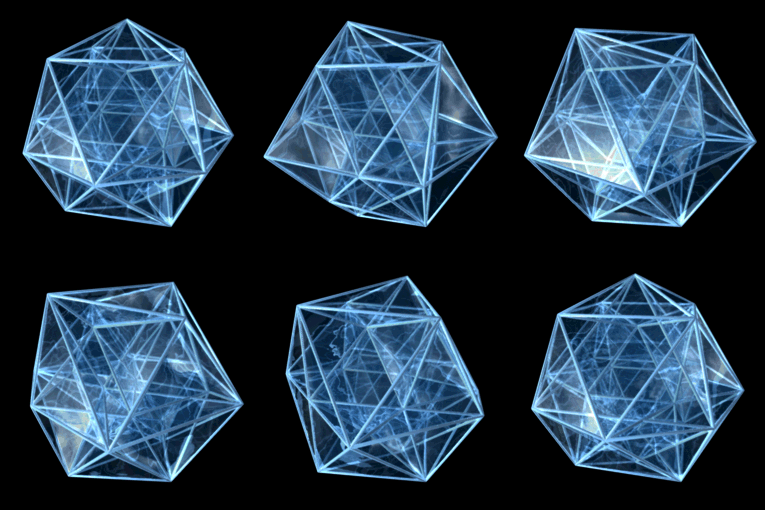
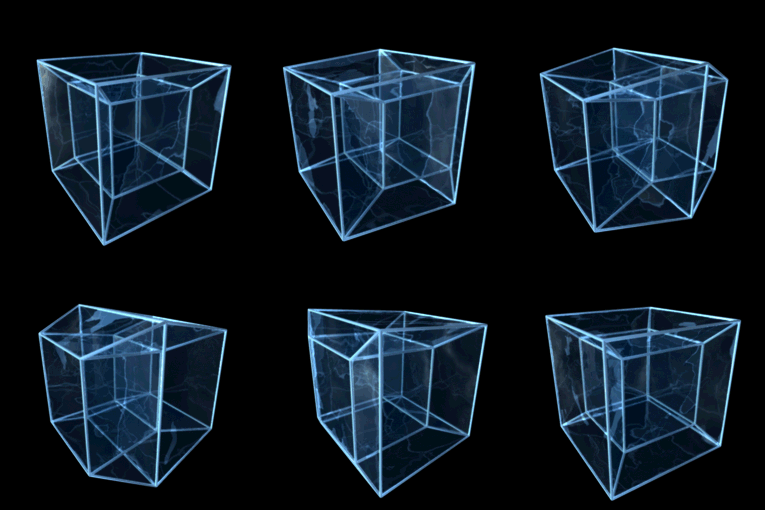


A higher dimension does not discard the geometry below it. It contains that geometry as part of its boundary structure.
square ⊂ cube ⊂ tesseract ⊂ penteract
The three-dimensional building block that appears on the boundary of a four-dimensional tesseract. In the same way, a tesseract becomes a four-dimensional boundary cell of a five-dimensional penteract.
(x) → (x,y) → (x,y,z) → (x,y,z,t) → (x,y,z,t,s)
Adding an axis creates a new family of connections between two displaced copies of the lower-dimensional object. A line can be viewed as two points connected along a new direction; a square as two lines connected along a second direction; a cube as two squares connected along a third; a tesseract as two cubes connected along a fourth; and a penteract as two tesseracts connected along a fifth.
I³ is a facet of ∂I⁴, and I⁴ is a facet of ∂I⁵
∂I⁴ = 8 I³, ∂I⁵ = 10 I⁴
V₃ = span{x,y,z} ⊂ V₄ = span{x,y,z,t} ⊂ V₅ = span{x,y,z,t,s}
M³ ↔ boundary / cross-section of M⁴
M⁴ ↔ boundary / cross-section of M⁵
Each dimensional step is generated by adding one independent axis. The lower-dimensional object remains present as part of the higher-dimensional boundary structure.


Dimensional Nesting
Simple Boundary Logic



Φ Field (1,5,10,105,1) 5D Boundary:
10 tesseract facets
Penteract face = Tesseract (1,4,6,4,1)
Hyper-volumetric surfaces with shared spatial points, all space and time are merged as coherence.
Stabilized Coherence
Ψ Wave 1,4,6,4,1) 4D Boundary:
8 cube facets
Tesseract face = Cube (1,3,3,1)
Volumetric surfaces spanning time
Partial Coherence, not stabilized in s
ρ Local (1,3,3,1) 3D Boundary:
6 square facets
Cube face = Plane (1,2,1)
Perceives cross-sections of time and space
Incoherent to t and s

Boundary Logic:
Each dimension (3D, 4D and 5D) follow the same geometrical nested hierarchy. Any objects within their respective dimension, moves strictly based on their axis of movements, x, y, z, t and/or s. This decides physical laws per dimension. (All dimensions follow this hierarchy.)
(Φ) 5D: moves within boundaries of length, width, height, time, space with information in 4D hyper-volume surfaces.
(Ψ) 4D: moves within boundaries of length, width, height, time with information in 3D volume surfaces.
(ρ) 3D: moves within boundaries of length, width, height with information in 2D planar surfaces.
(⟂) 2D: a 3D observer's cross-sections of t and s.
Geometric Time

3D observer: The cross-section of 4D, experienced in 2D frames (faces) ⟂
(Ψ→ ρ → ⟂ = t)
In special relativity, E = mc² emerges from Lorentz invariance and the constancy of c. Quantum theory, meanwhile, treats the wavefunction in an abstract Hilbert space. The DM framework embeds both within a nested geometric hierarchy:
ρ (3D localized), Ψ (4D wave), and Φ (5D coherence). Here, c is the scan speed that advances 3D faces through 4D frames, hence it plays a dual role as both causal speed limit and geometric necessity.
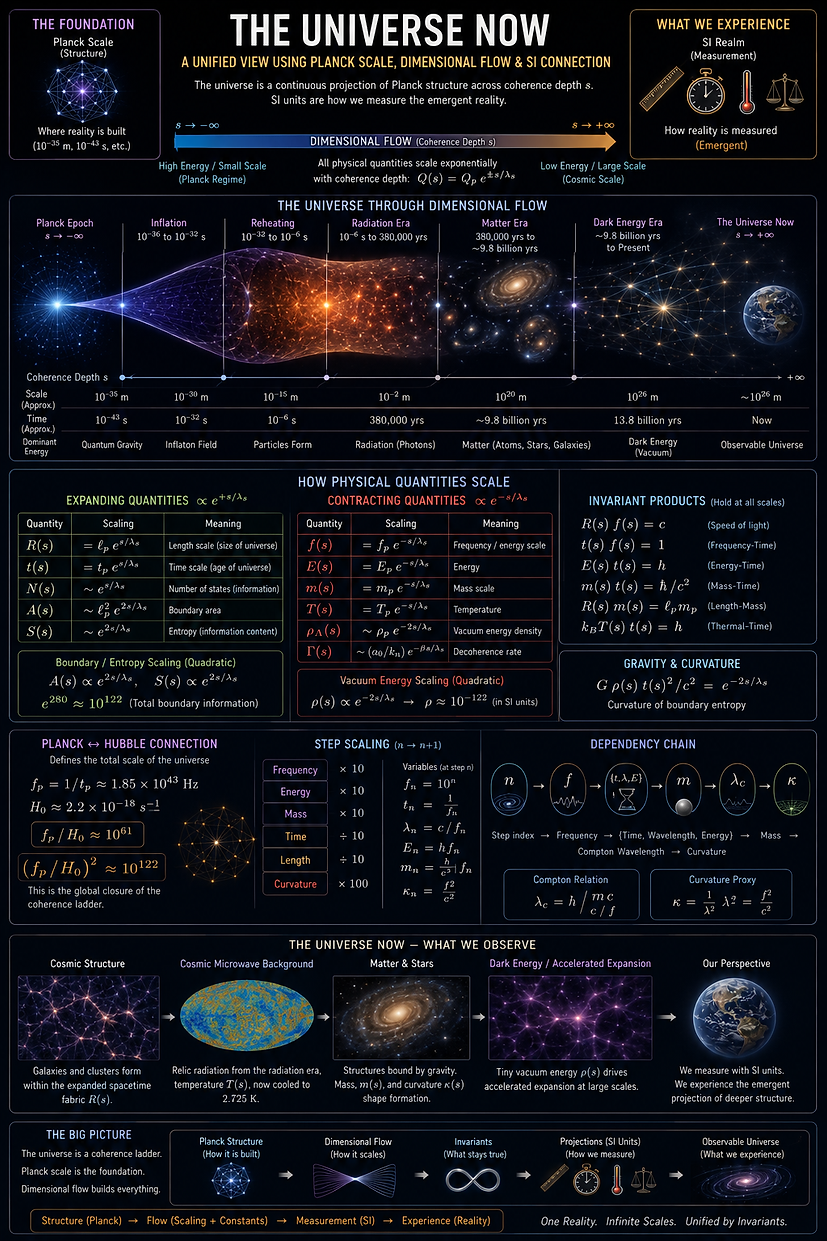
c = ℓₚ / tₚ
Simultaneously, the frame rate of this scan is the Planck frequency:
ƒₚ = 1 / tₚ
A 3D localized mass (m) is a ‘stilled wave’—energy constrained to ρ. Releasing that localization exposes the underlying 4D wave energy, and the conversion is governed by the scan rate c. Thus, the energy content associated with mass (m) is:
E = m c²
Interpreting mass as a localized wave explains why E = mc² holds universally—energy and mass are two presentations of the same entity.
Time is a 3D cube revolving through a 4D tesseract, consecutively perceiving cube faces (⟂):
Rate ≈ 1 / tₚ ≈ 1.85 × 10⁴³ faces per second
This 'face rate' (⟂) is the frame rate of 3D reality. Each Planck tick corresponds to one face transition of the 4D tesseract, progressing the 3D universe forward in time — each scale jump also crosses the penteract. (Eames' Powers of Ten concept mirrors how 4D scanning operates)
Dimensional Memorandum reframes physics as a fully geometric system where perception, particles, forces, and time itself emerge from structured coherence transitions between dimensions.
The 3D world is a cross-section of a vast 5D coherence lattice—a flickering sequence of stabilized information frames projected into our awareness at Planck resolution. Everything we observe is merely a face of a deeper structure.
In 3D, faces are 2D surfaces → particles appear on flat detectors. In 4D, faces are 3D volumes → wavefunctions spread volumetrically. In 5D, faces are 4D hypervolumes → entangled states sharing space and time in full coherence.
DM clarifies- that reality is not built from particles or waves alone, but from coherence—the underlying field binding existence across all of space and time (entanglement is localized coherence). Once this is understood, unifying quantum mechanics, gravity, consciousness, and cosmology becomes not only possible—but inevitable.